


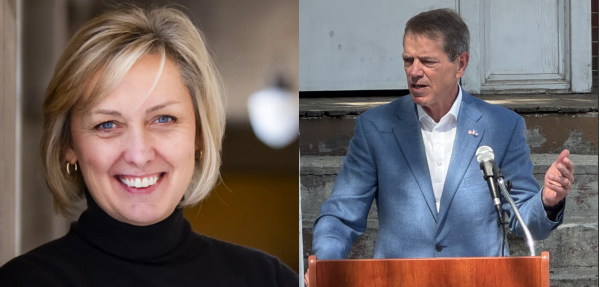
Nebraska Gov. Jim Pillen and Democratic gubernatorial challenger Lynne Walz agree that property taxes remain a major concern for Nebraskans, but the candidates offer different approaches to providing relief, funding education and addressing medical marijuana access.
In separate interviews with KLIN News, the Republican incumbent emphasized reducing state government spending, building support among lawmakers and continuing his administration’s tax-cutting efforts. Walz called for a more gradual approach to property tax relief, stronger support for teachers and immediate action to expand access to medical marijuana.
Property tax relief remains one of Pillen’s biggest unfinished goals as he seeks a second term. “There’s no question the most difficult one that nobody’s been able to tackle for the last 50 years has been property tax reform,” Pillen says.
The governor said his administration has made progress in slowing property tax increases but acknowledged that some homeowners and landowners have yet to see meaningful reductions in their bills. “What we’re doing is not sustainable,” Pillen says. “And that’s why it needs to get fixed at the state level.” Pillen says advancing additional reforms will require stronger relationships with state senators and the 33 votes needed to move legislation through the Nebraska Legislature.
Walz, a former state lawmaker and teacher, criticized Pillen’s emphasis on income tax cuts, saying property tax relief is what she consistently heard from residents while campaigning. “When I was running for the Legislature, every door I knocked, people talked about property tax,” Walz says. “I did not hear them talk about income tax relief. I did not hear them say, ‘Gosh, I really wish I had income tax cuts.’ It was always, ‘I need property tax relief.’”
Walz said the state must address a projected budget deficit while pursuing sustainable, long-term property tax relief. Her proposals include expanding homestead exemptions and considering an exemption for the first $100,000 of property valuation. She also wants to restore the share of allocated income tax revenue directed back to local communities through the state’s school funding formula.
Walz said that share has fallen from 20% when the formula was created to about 2%. Walz acknowledged that meaningful relief would take time. “It does have to be incremental. It does have to be gradual,” she said, arguing that lawmakers must protect essential public services while working toward lower property taxes.
Pillen defended his income tax cuts, saying they are intended to leave more money in taxpayers’ pockets. He argued that additional tax relief must be accompanied by efforts to control government spending. “We’ve been spending too much money in state government for over 20 years,” Pillen says. “We’ve got to say no to things.”
Pillen said state agencies should improve efficiency, use technology more effectively and eliminate waste rather than continue expanding government spending. Walz, meanwhile, says balancing the budget must be part of her approach to property tax relief.
Her proposals focus on changing how state revenue supports local communities and reducing property tax burdens without undermining public service. The candidates also outlined different priorities for education, although both said schools and students should remain a focus of state government.
Pillen said he would not compromise education funding as his administration works to control spending. “Education is the key to lifting kids up,” Pillen says. “That’s highest priority. Education is not going to be compromised. We’re strengthening it.”
Pillen highlighted a federal scholarship tax incentive that he said could provide additional resources for public schools, private schools and homeschooling families. He also pointed to Nebraska’s Jobs for America’s Graduates program as a way to help prepare students for future careers.
Walz, who served eight years on the Legislature’s Education Committee, said she would prioritize teachers, classroom resources and student mental health. She says Nebraska needs to do more to retain teachers by providing the support and incentives necessary to keep them in the state.
Walz also emphasized addressing students’ mental health needs, which she said affect learning and classroom environments. Her approach places greater emphasis on supporting educators and addressing students’ needs inside the classroom, while Pillen highlighted education funding and programs intended to expand opportunities for students.
Pillen acknowledged that he learned during his first term that advancing his agenda requires patience and stronger working relationships with state senators. He said he sometimes pushed too hard and wants to do a better job building consensus if reelected.
Walz said her priorities also include growing Nebraska’s economy to help address affordability concerns involving housing, child care and other household expenses. She said attracting businesses and strengthening economic development efforts would benefit communities across the state.
She also emphasized transparency and accountability in government. “I do not work for my party. I work for the people of Nebraska,” Walz says.
The candidates’ contrasting approaches reflect a broader choice for voters: Pillen is asking for another term to continue his tax-cutting agenda and pursue additional property tax reforms, while Walz is proposing changes to state revenue distribution, education priorities and medical marijuana access.